

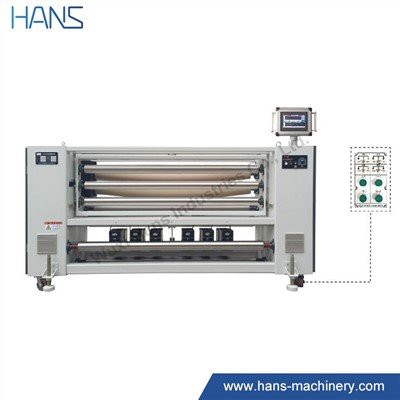
The stand-alone weft straightener is designed for knitted and light elastic woven fabric and sets new standards for the straightening of skew and bow distortions in sensitive fabric. Advantages & Technical Data. Fields of applications.
Benefits of Knit Weft Straightener
Enhanced Fabric Quality
By straightening the yarn as it enters the knitting machine, the weft straightener ensures that the resulting fabric has a more uniform texture and appearance. This is particularly important for achieving consistent stitch patterns and avoiding defects.
Increased Production Speed
With the yarn properly aligned, knitting machines can operate at higher speeds without compromising the quality of the fabric. This leads to increased throughput and better utilization of production facilities.
Reduced Maintenance Costs
Properly aligned yarns reduce wear and tear on looms and other machinery, leading to fewer breakdowns and lower maintenance costs.
Energy Efficiency
When knitting machines operate smoothly, they tend to consume less energy. The weft straightener contributes to this by ensuring that the yarn feed is optimized, reducing the power required to drive the machine.
Better Machine Performance
Yarns that are not straight can cause irregularities in the weaving or knitting process, leading to machine jams and downtime. Weft straighteners help maintain smooth operation and reduce downtime.
-
![Automatic Weft Straightener]() Add to Inquiry
Add to Inquiry -
![Open Width Knit Stenter Machine]()
Open Width Knit Stenter Machine
Add to Inquiry -
![Knitted Auto Weft Straightener]()
Knitted Auto Weft Straightener
Add to Inquiry -
![Knit Fabric Weft Straightener]() Add to Inquiry
Add to Inquiry -
![Woven Fabric Weft Straightener]()
Woven Fabric Weft Straightener
Add to Inquiry -
![Stenter Machine Weft Straightener]()
Stenter Machine Weft Straightener
Add to Inquiry -
![Automatic Optical Weft Straightener]()
Automatic Optical Weft Straightener
Add to Inquiry -
![Printing Machine Weft Straightener]()
Printing Machine Weft Straightener
Add to Inquiry



Why Choose Us
Customer service
We firmly believe that we offer THE BEST customer support in the industry and it is our ongoing goal to continually improve on our services. As an independently owned and operated business, we are able to provide the most accommodating service possible.
Advanced equipment
We take great measures to ensure that we work with the industry' s highest quality equipment and that our equipment is regularly and meticulously maintained.
Competitive prices
We offer our products at competitive prices, making them affordable for our customers. We believe that high-quality products should not come at a premium, and we strive to make our products accessible to all.
Efficient and convenient
The company has established marketing networks around the world to provide high-quality services to customers in an efficient and convenient manner.
High quality products
We always put customer needs and expectations in the first place, refine on, continuous improvement, to seek every opportunity to do better, to provide customers with their expectations of quality products, to provide customers with the most satisfactory service at anytime.
Professional team
We have a team of skilled and experienced professionals who are well-versed in the latest technology and industry standards. Our team is dedicated to ensuring that our customers get the best service and support possible.

Weft Straightener Market size was valued at USD 24 Billion in 2023 and is expected to reach USD 30 Billion by the end of 2030 with a CAGR of 3.24% during the forecast period 2024-2030.
The segment of the textile industry devoted to the production, sale, and upkeep of weft straightening machines is known as the Weft Straightener Market. In order to preserve the integrity and quality of the fabric, these machines' specialised technology corrects distortions in woven fabrics by making sure the weft threads run perpendicular to the warp threads.
In textile mills, apparel manufacturing facilities, and other textile-related businesses, weft straightening machines are frequently utilised to guarantee that fabrics fulfil exact quality standards prior to additional processing, such as cutting, stitching, or dyeing. These devices contribute to waste reduction and uniformity in textile goods by automatically identifying and adjusting skew and bow in woven materials.
The Weft Straightener Market includes a variety of equipment types and technologies, ranging from sophisticated computerised systems to conventional mechanical straighteners. These devices identify fabric distortions and implement corrective action using sensors and automated controls. Weft straighteners on their own and integrated systems as part of larger fabric processing lines are both available on the market.
The existing weft-straightening machine for woven fabrics has poor corrective effect on common types of weft skewness such as double bow and double hook, and computation for readjustment of rotating speed is complex for the weft-straightening machine. Accordingly, an improved scheme of weft-straightening machine was designed and experimented. Firstly, an improved structure of multi-roll weft straightener was proposed after analyzing the principle of weft straightening of roller weft straightener. The equation was used to simulate the common weft skew types, and the initial weft shape was obtained for calculating the weft slope of the fabric before weft correction. Eight points on the weft was used to describe the weft slope, and the simulation database of weft skew detection was thus established. Finally, a method was designed to obtain the adjustments of each weft roll by using the least square method based on the detected weft inclination data, reducing the computational complexity and enabling the calculation of the weft slope after weft rectification according to the final orientation of the weft. Experimental results show that the effect of weft-straightening machine is improved by readjusting the weft straightener, leading to a 100% first-class fabric qualification rate for different types of weft skew problems.

Application Scope of Textile Weft Straightening Machine
Textile production field
Textile weft straightening machine is mainly used in the production process of various textiles such as cotton, wool, linen, silk, chemical fiber, etc. By finishing and trimming the edges of the fabric, the textile weft straightening machine can improve the appearance quality and durability of the textile and increase production efficiency.
Garment processing field
In the process of garment processing, the textile weft straightening machine also plays an important role. It can trim the edges of the cloth so that the width and length of the entire cloth meet the standard requirements, ensuring that the size and size of the clothing are accurate.
Automobile interior field
Textile weft straightening machine is also widely used in the field of automobile interior. It can process automobile interior materials of various shapes and sizes, enhance the strength and durability of the materials, and improve the quality and comfort of automobile interior.
Design of Weft Detection System in The Stenter Machine
In order to build an effective automatic weft-straightening system, it is important for the sensing device to detect most the possible fabric styles, designs, colours and structures, an optical sensing system that detects the angular orientation of weft threads in a moving web of a textile has been built. It contains an adjustable light source, two lens systems and photodiode sensor array. The sensor array includes 13 radial pattern of photosensitive areas that each generate an electrical signal proportional to the total intensity of the light incident on the area. The moving shadow of a weft thread passing over the area will modulate the output signal. A signal processed circuit was built to do the I/V conversion, amplifying, hardware filtering. An embed micro control system then deals with the information of these signals, calculates the angle of the weft drew. Finally, the experiments were done, the results showed that the weft detection system can deal with the fabric weft skew up to 30° and has achieved good results in the application.

Weft straightener is an important process to control the final quality of the fabrics. It is needed to calibrate the distorted weft after dyeing process. During various fabric treatment processes, the fabric is almost done with heat treatment through a tenter machine. At this time, weft distortion is occurred with uneven tension distribution. Traditionally, photo sensor is commonly used to detect the weft distortion but it is not applicable for special fabric types such as twill, mesh, combi, etc. In this paper, a new method for detecting the weft distortion using camera is introduced. A new weft straightener simulator is also developed to test the ability of the proposed method. It is shown that the method can be applied for various fabric types.
Open Width Knits Hot Air Stenter Machine Main Technical Specifications
|
The working width of the machine: |
1200-3800mm |
|
Production line speed: |
10-150M / min |
|
Maximum use of tension: |
1500kgf/3600mm |
|
Heat source |
Natural gas direct combustion / heat transfer oil / medium pressure steam |
|
Drying room temperature: |
MAX230℃ |
|
Drying room heating form: |
Hot air circulation |
|
Temperature control: |
Digital scale proportional automatic temperature control |
The Weft Straightener Market is poised for substantial growth in the coming years, driven by several key strategies and factors. Market players are increasingly focusing on product innovation and development to meet evolving consumer demands and preferences. Expansion into emerging markets and strategic partnerships or collaborations are also pivotal strategies for market growth. Additionally, investments in research and development to enhance technological advancements and improve product quality play a vital role. Moreover, the market's future scope looks promising due to the rising adoption of digitalization and the integration of advanced technologies, which are anticipated to open new avenues for growth and innovation.

Functions Of A Stenter Machine In Textile Industry
Mechanical Finishing
The stenter imparts a specific mechanical finish to fabrics, affecting their appearance and feel. This process, often referred to as the ‘stenter finish,’ enhances the aesthetic and tactile qualities of the fabric.
Heat Setting
Essential for fabrics like lycra, synthetic, and blended materials, the stenter machine performs heat setting. This process stabilizes the size and shape of the fabric, making it more resilient to subsequent processing and use.
Width Control
One of the unique capabilities of the stenter is controlling and adjusting the width of the fabric during drying. This ensures that the fabric meets precise dimensional specifications.
Finishing Agent Application
The stenter applies various finishing agents to the fabric, enhancing its properties and performance. This includes treatments for color, texture, and other functional attributes.
Control of Knit Loop
For knit fabrics, the stenter plays a crucial role in controlling the loop size and structure, impacting the fabric’s final texture and elasticity.
Moisture Control
Maintaining optimal moisture content in the fabric is another crucial function of the stenter, ensuring the fabric doesn’t become too dry or retain excessive moisture.
Control of Spirality
The stenter helps in controlling spirality in fabrics, which is essential to maintain the fabric’s shape and prevent twisting during subsequent processes or use.
GSM Control
GSM (Grams per Square Meter), an indicator of fabric weight, is controlled and standardized in the stentering process to meet specific requirements.
Drying
The stenter efficiently dries fabrics, a fundamental part of the textile finishing process.
Shrinkage Control
It plays a vital role in controlling the shrinkage properties of the fabric, ensuring dimensional stability after the manufacturing process.
Curing Treatments
The machine is used for curing treatments for specialized finishes like resin application and water repellent treatments, enhancing the fabric’s functional properties.
Our Factory
Hans Industries (Wuxi) Co., Ltd is a specialist manufacturer in Textile Finishing Machinery. We major produce: Automatic Fabric Slitting Machine, Rope opener, Tube Sewing machine, Automatic Weft Straightener etc.


FAQ
We're professional weft straightener manufacturers and suppliers in China, specialized in providing high quality custom service. We warmly welcome you to buy high-grade weft straightener at competitive price from our factory. Contact us for more details.
